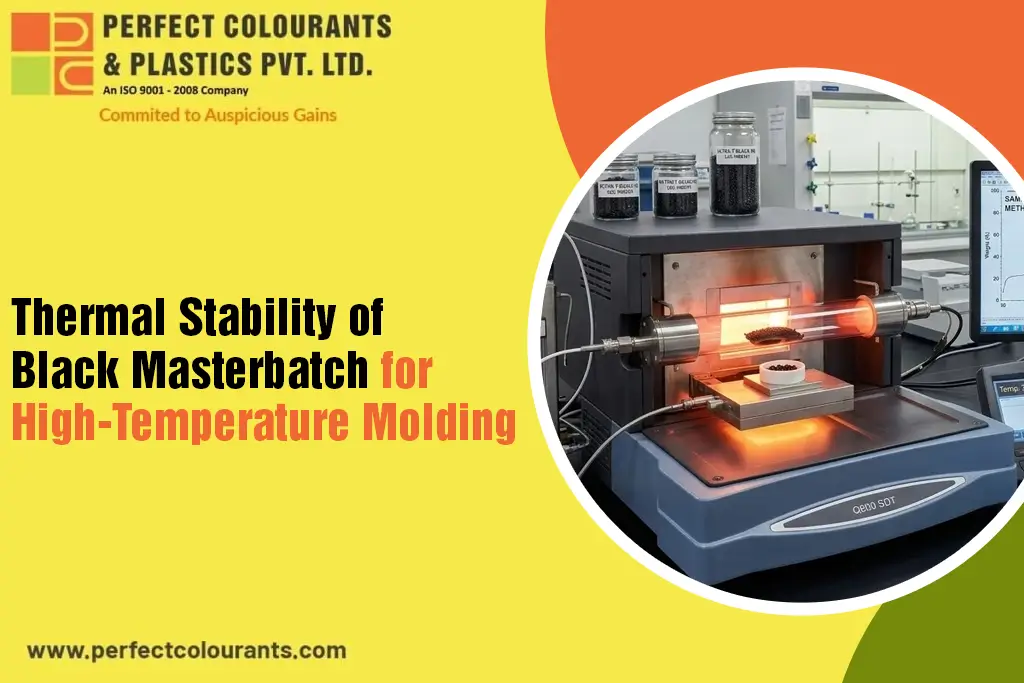
Thermal Stability of Black Masterbatch for High-Temperature Molding - Performance Evaluation of Carbon Black Grades and Carrier Polymers
As global OEMs are moving towards high-performance polymers like PC, PA and other engineering plastics, molding temperatures are increasingly exceeds upto 280-degree celsius, reaching upto 320 to 350-degree celsius in certain applications.
In various applications, molders reported:
➤ Progressive brown undertone at elevated barrel temperatures
➤ Surface haze and gloss loss
➤ Volatile formation during extended residence time
➤ Melt flow instability across multiple cycles
To address this challenge, Perfect Colourants & Plastics Pvt.Ltd conducted an internal R&D evaluation that focuses on the interaction between carbon black grades, carrier polymer and stabilization under high-temperature conditions.
Scope of Study
➤ Processing windows: 260-degree Celsius to 320 -degree Celsius
➤ Engineering polymers: PC, PA compatible resin systems
➤ Comparative evaluation of carbon black surface area & structure
➤ Multiple thermal stability stimulation
➤ Oxidative stability monitoring
The objective was not simply to maximize tint strength, but to achieve consistent thermal performance under realistic molding conditions.
Understanding the Degradation Mechanism
Carbon black stays thermally stable well above molding temperatures under inert conditions. Instability is observed during processing, originating from thermo-oxidative degradation of the polymer matrix.
The degradation mechanism is as follows:
➤ Oxygen diffusion into the molten polymer: Oxygen dissolves into the molten polymer.
➤ Radical formation due to the heat: Heat initiates radical formation
➤ Chain scission or localized crosslinking: Polymer backbone breaks & viscosity changes.
➤ Stabilizer Interaction: High surface carbon black may adsorb stabilizers, reducing effective concentration.
➤ Secondary discolouration and volatile occurrence: Gas evolution, brown undertone, gloss reduction and odour formation.
PPCPL R&D team hypothesized that thermal instability at high temperatures is governed by:
➤ Carrier polymer thermo-oxidative resistance
➤ Carbon black surface area & structure
➤ Stabilizer–carbon black interaction
➤ Residence time & oxygen exposure
Carbon black itself remains thermally stable; instability arises from polymer degradation dynamics.
Carbon Black Grades Evaluation
➤ High-surface Area (N220 equivalent): High surface area implies higher tint strength & higher absorption potential.
➤ Medium-surface Area (N330 equivalent): Medium structure offers a balanced performance.
➤ Low-surface Area (N660 equivalent): Very low surface grades exhibit improved processability & lower interaction.
➤ Thermal black (N990 class): Very low surface thermal blacks.
Observations
➤ The high surface grades improved jetness but increased viscosity and shear sensitivity at >300-degree celsius.
➤ Excess surface increased the chances of antioxidant interaction
➤ Medium structure grades demonstrated better process stability while maintaining a deep black tone.
➤ The very low surface grades offered a better flow stability but required a higher dosage to achieve an equivalent depth of shade.
The findings confirmed that higher tint strength does not automatically translate to higher thermal stability.
Carrier Polymer Influence
Carrier selection proved to be the most important factor in high-temperature applications:

When molding temperatures approach 300°C, carrier compatibility with the end-use engineering polymer becomes critical. Polyolefin carriers are typically unsuitable for sustained processing in this range. Moisture control in PA and PC systems was equally important, as hydrolytic degradation accelerates oxidative instability.
Validation Protocol
Each optimized formulation underwent:
➤ Thermogravimetric screening under inert and oxidative atmospheres
➤ Melt flow tracking after repeated thermal cycles
➤ Colour stability (ΔE) monitoring
➤ Surface and gloss inspection
➤ Controlled ageing evaluation
The validation confirmed that properly engineered medium-structure carbon black combined with an engineering-grade carrier system maintained consistent performance through repeated exposure to high processing temperatures.
PCPPL’s Recommendation for High-temperature Molding for Applications Above 280°C
➤ Avoid high-surface-area grades unless required for functional performance
➤ Medium-structure carbon black with Low-ash, low-extractable grade
➤ Maintain strict moisture management in hygroscopic polymers
➤ Validate oxidative stability beyond single-pass processing
➤ Match the carrier polymer to the engineering resin being molded
We Can Conclude
Thermal stability of black masterbatch in high-temperature molding environments is governed by formulation engineering rather than pigment concentration alone. Through its in-house R&D, QC validation and modern production system, PPCPL develops black masterbatch solutions suitable for demanding processing conditions in engineering polymer applications. Technical data sheets, sample evaluations, and application consultations are available upon request for customers evaluating high-temperature black masterbatch solutions manufactured in India for export markets.