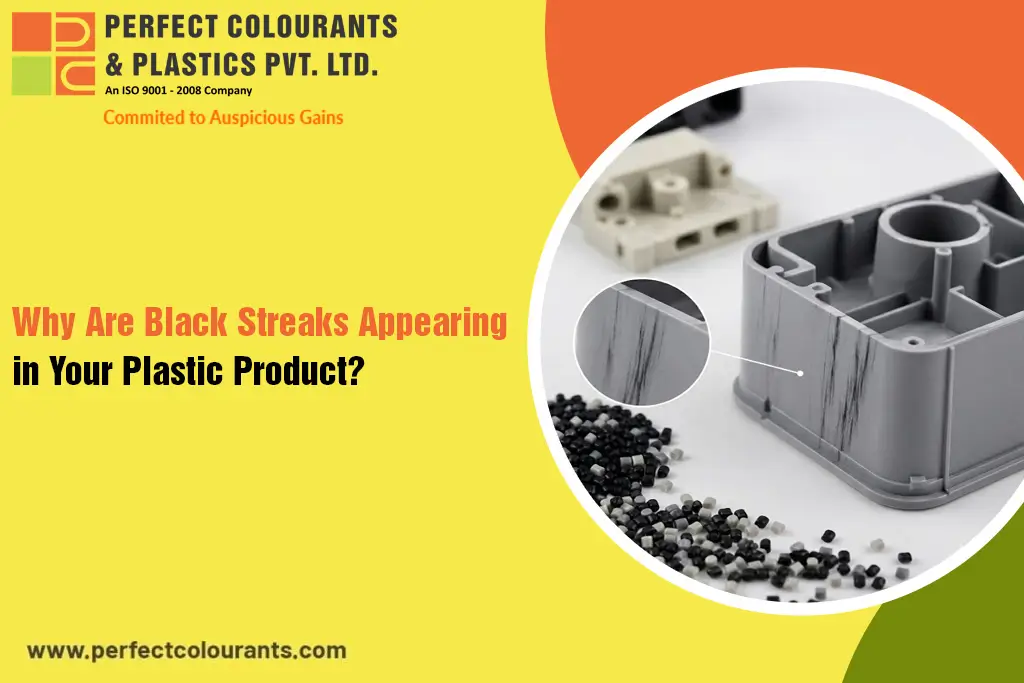
Why Are Black Streaks Appearing in Your Plastic Product?
Black specks or streaks are one of the most common plastic problems. These defects can often affect the appearance of the end products and lead to rejections. Black streaks and impurities are characterised by small dark particles, and the larger impurities are fragile and brittle. These defects can appear randomly over a plastic part or only in a specific area. Whether you are manufacturing packaging films, injected molded products, pipes, containers or consumer products, black streaks can significantly impact product appearance.
The challenge of black streaks is often due to various reasons. In some cases, the problem can originate from degraded polymer material. In others, it can be associated with poor machine maintenance, contamination, material compatibility or process design. In this masterbatch guide, we understand why black streaks appear in plastic products and what corrective action to take to counter this challenge.
What are the Black Streaks in Plastic Products?
Black streaks in plastic products can occur in the following forms:
- Linear dark streaks along the flow direction
- Localised black specks or spots.
- Dark discolouration localised near injection gates or sharp corners
The Root Causes of Black Streaks in Plastic Processing
1. Thermal Degradation of Base Polymer
When the processing temperature exceeds the thermal stability threshold of the polymer, the material begins to degrade and char. The charred fragments turn dark brown to black and flow with the melt, depositing as streaks on the surface or through the body of the part. This is one of the most common problems of black streaks in heat-sensitive resins like POM and PVC.
2. Poor Carbon Black Dispersion in Masterbatch
When a black masterbatch exhibits poor dispersion, meaning the black particles are not fully broken down and distributed in the carrier resin. These undispersed particles pass through the system and appear as dark specs, streaks or uneven colouration in the final part. High-surface area carbon blacks are particularly difficult to disperse and require high-shear compounding to achieve clean results.
3. Contamination from Previous Material or Colour
Residue from a previous production run, especially dark or black resins, can leave residue on the barrel, screw grooves, nozzles or hot runner cavities and contaminate the next run. Even a small amount of black masterbatch residue will appear as streaks in white or transparent product. Inadequate use of purging compounds between colour changes is the main cause of this issue.
4. Dead Zones in Mould, Runner or Hot Runner Systems
Any area where melt flow stagnates, like sharp corners, poorly designed runners, oversized sprues, or inadequately balanced hot runners, can create dead zones. Materials in a dead zone are exposed to heat without replacement, degrade progressively and purge into the dead zones as dark contamination.
What to Adjust and By How Much to Tackle Black Streaks?
- Temperature: If temperatures are confirmed to be above the resin’s upper processing limit, reduce in increments of 5-10 °C per zone, starting from the front zone nearest the nozzle, which has the most impact on melt temperature.
- Injection Speed: Very high speed at the end of fill compresses trapped air rapidly. To avoid this problem, fill at normal speed, then reduce the speed sharply in the final 10-15% of fill to allow air to escape through the vents before pressure builds.
- Screw Speed & Back Pressure: High-screw speed generates significant shear heat, which compounds barrel temperature and can push sensitive resins into degradation even when temperatures are nominally correct. Similarly, excessive back pressure increases shear and residence time. So reduce back pressure and verify it is appropriate for the masterbatch and resin combination in use.
The Role of Purging Compounds in Eliminating Black Streaks
When the source of black streaks is carbon deposits or contamination from a previous run, parameter adjustments alone cannot solve the problem. The physical deposits must be removed, and this is why purging compounds are required.
A purging compound works by passing a specially formulated material through the barrel, screw, nozzle and hot runner systems. This is particularly effective in hard-to-reach dead zones. The purging compound is run for several minutes at a moderate back pressure, allowing it to dwell briefly, then pushing through several shots to carry loosened deposits out of the system. This process is repeated until purge comes out clean.
PCPPL’s Products That Address Black Streak Problems
From purging compounds that eliminate carbon buildup to high-dispersion black masterbatches engineered for uniform colour, PCPPL’s technical products cover both the root cause and material side of black streak elimination. For more information, call us today.