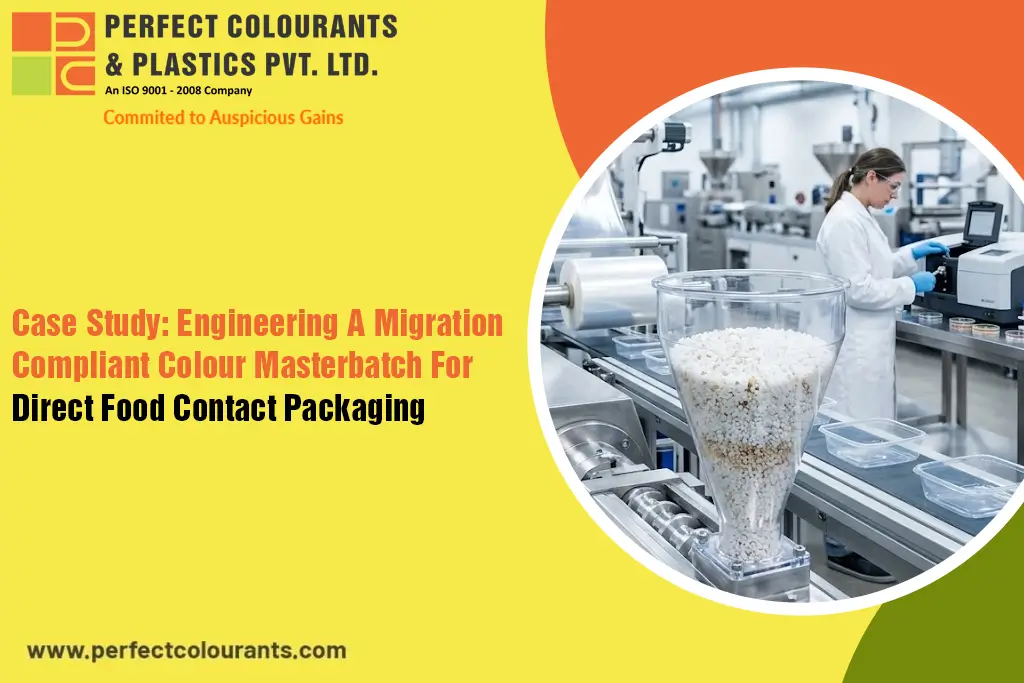
Engineering a Migration-compliant Colour Masterbatch for Direct Food Contact Packaging
The food packaging industry is bound by some of the most stringent regulatory standards. This is because the end products are consumed by humans, so there is no scope for compromise on quality standards. At Perfect Colourants & Plastics Pvt.Ltd, we were approached by a flexible packaging manufacturer who needed a brand-accurate colour that could legally touch food across European and FDA-aligned export markets. PCPPL’s R&D and in-house testing worked tirelessly to pass the bottleneck into a single formulation.
Client Profile
- Industry: Flexible packaging manufacturer, West India
- Output: PP/PE laminated pouches & PET trays
- End Use: Snack, spice and dairy label
- Process: Cast film extrusion, blown film
The Requirements
- One Pack Two Regulators: The same pouch design shipped to EU retailers and US stores, each governed by a different positive list and a different migration testing regime.
- Heavy-metal-free, not just ‘Low’: The brand’s own colour reference relied on pigment chemistry that in some commercial grades carried traces of heavy metal above what either jurisdiction allows in food-contact use.
- Consistency at Low Dosage: The manufacturer’s line of equipment depended on holding masterbatch under 2% let down. Any colour solution requiring a higher loading would affect the film's transparency and increase material costs.
- Documentation, Not Just Dye: The brand’s own quality team needed a Declaration of Compliance and migration data before the film could be approved, not just a colour-matched sample.
PCPPL’s Approach
Migration compliance is decided at the formulation stage, not the testing stage. At PCPPL, regulatory requirements are considered from the beginning, ensuring the final testing validates compliance rather than revealing unexpected issues.
- Positive-list Pigment Screening: Every masterbatch is checked against EU and FDA standards before it enters trial, ruling out chemistry that would fail before any time is spent on colour matching.
- Carrier Resin & Dosage Engineering: The carrier resin is matched to the manufacturer's specific process, cast film extrusions in this case. The letdown ratio is optimized to achieve colour strength and opacity hold while maintaining efficient production line.
- In-house Migration & Heavy Metal Testing: Overall Migration (OML) and Specific Migration (SML) screening, including heavy metals like lead, cadmium, mercury and hexavalent chromium testing, is conducted at PCPPL’s in-house testing labs. This ensures regulatory compliance is evaluated early, reducing the risk of delays during final approval.
- Pilot Run & Colour Validation: A production-scale trial runs the masterbatch against the brand’s RAL or Pantone reference before the formulation is released for bulk production.
The Results
- Market Access: The final masterbatch formulation met the compliance requirements for both EU and US food packaging applications. As a result, the customer could use a single formulation for the same pouch design across multiple markets, reducing inventory complexity and simplifying production management.
- Economical Production: The masterbatch delivered the required colour performance at a 2% letdown ratio, enabling the manufacturer to maintain film clarity, production efficiency and existing cost targets without increasing masterbatch consumption.
- Audit Readiness: The Declaration of Compliance and migration test data were supplied with the first production batch, giving the manufacturer's quality assurance team immediate access to the documentation.
- Repeatability: The validated formulation is securely recorded for future production runs, allowing repeat orders to be manufactured using the same approved recipe. This ensured consistent colour performance and regulatory compliance while eliminating the need to repeat the development process for each order.
At Perfect Colourants & Plastics Pvt.Ltd, as India's largest masterbatch manufacturer, our in-house testing and R&D labs ensure the clients receive MBs that comply with the industry’s most rigorous quality standards. This eliminates compliance issues in later stages and ensures clients receive masterbatch that is colour-matched, dosage-optimized and compliance documents attached. Talk to PCPPL today to discuss your requirements.
Frequently Asked Questions (FAQs)
1. What makes a colour masterbatch ‘migration compliant’ for food packaging?
It means every resin, pigment and additive in the formulation complies with EU and US FDA regulations. The masterbatch formulation's Verified Overall Migration (OML) and Substance-specific Migration (SML) are within the framework's limits.
2. Can the same masterbatch formulation satisfy both EU and FDA requirements?
Yes, provided every raw material is checked against positive lists at the formulation stage.
3. Does migration compliance limit the colour options?
No. PCPPL maintains a food-contact colour masterbatch that matches most brand colour references, including RAL and Pantone codes.
4. What documents should a packaging manufacturer expect from their masterbatch supplier?
A Declaration of Compliance referencing the exact regulations that are met, overall and specific migration tests, a certificate of analysis for the supplied batch, and confirmation that production follows Good Manufacturing Practice (GMP).
5. How long does it take to develop a new compliant colour from brief to bulk production?
An existing colour from a colour shadecard can take less time, while a custom colour can take longer time.