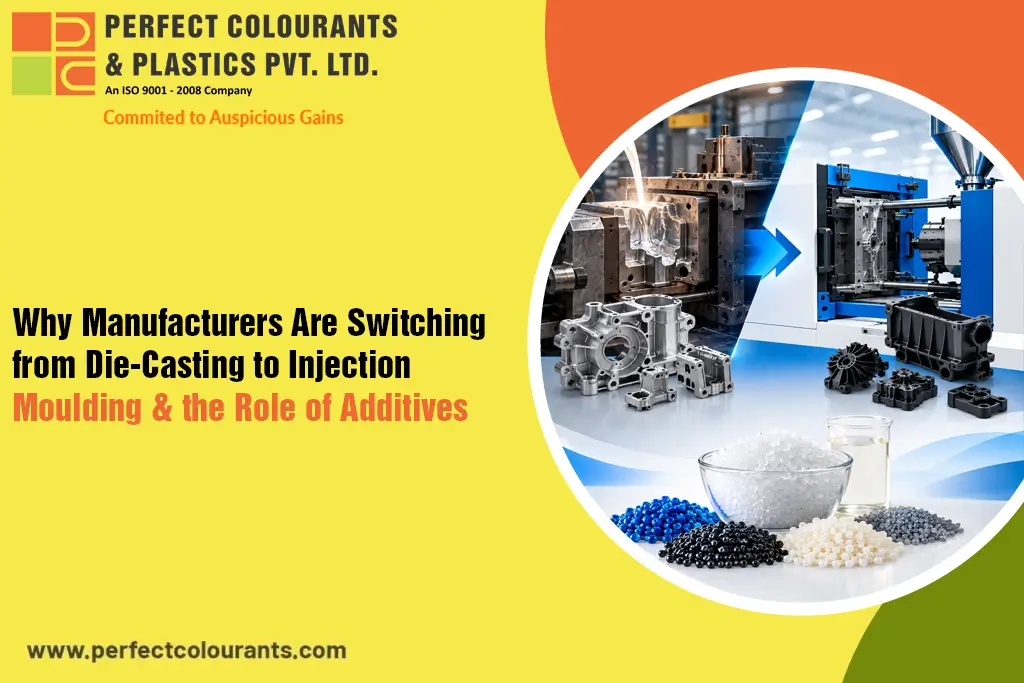
Why Manufacturers Are Switching from Die-Casting to Injection Moulding & the Role of Additive Masterbatches
For decades, die-casting was the go-to choice when manufacturers needed components that were strong, durable, and capable of withstanding demanding conditions. But across the automotive, electrical, appliance, and consumer goods industries, that conventional approach posed several challenges. Manufacturers are turning to injection-moulded plastic components as alternatives to die-cast metal parts in many applications. This is because of advantages including that plastics can reduce component weight, simplify complex designs, lower manufacturing costs, and offer greater flexibility in colour, finish, and functionality. But replacing metal with plastic is not as simple as changing the material. This is where additive masterbatch becomes an important part of the production process.
Why Manufacturers Are Switching from Die-Casting to Injection Moulding
The move from die-casting to injection moulding is being driven by practical advantages in weight, cost, design flexibility, production efficiency, and part performance.
➤ Lighter Weight: Plastic components can weigh significantly less than comparable metal parts. In automotive applications, reducing component weight can contribute to improved fuel economy or electric-vehicle range.
➤ Lower Production Costs: Injection moulding can offer competitive per-part costs, particularly in high-volume production. Once the mould is established, automated production and relatively low processing temperatures can help reduce manufacturing costs.
➤ Greater Design Freedom: Injection moulding allows manufacturers to produce complex geometries, thin walls, integrated features, and detailed surfaces in a single operation.
➤ Corrosion Resistance: Unlike many metals, plastics do not rust and can offer strong resistance to moisture and many chemicals.
➤ Energy Saving: Plastic processing can require less energy than some metal-processing operations. Lightweight plastic components can also contribute to material and transportation savings in certain applications.
Role of Additive Masterbatches in Injection Moulding
An additive masterbatch is a concentrated blend of functional additives incorporated into a polymer during plastic processing. By modifying specific properties of the base material, it can help injection-moulded plastics meet the performance, safety, durability, and processing requirements of applications traditionally served by metal.
➤ UV Masterbatch: Protects plastic components exposed to sunlight and UV radiation, helping reduce discolouration, embrittlement, and loss of mechanical performance. They are particularly useful for automotive, outdoor, and other UV-exposed applications.
➤ Flame Retardant Masterbatch: It helps reduce the flammability of plastic components and supports the fire-safety requirements of electrical, electronic, appliance, and other demanding applications.
➤ Antioxidant Masterbatch: It helps protect polymers against oxidation caused by heat, oxygen, and processing conditions, helping maintain material properties and extend service life.
➤ Impact Modifier Masterbatch: It improves the toughness and impact resistance of selected polymers, helping components withstand shocks, drops, vibration, and mechanical stress.
➤ Anti Scratch Masterbatch: It improves resistance to surface damage, helping maintain the appearance and durability of components that experience frequent handling or abrasion.
➤ Antistatic Masterbatch: It helps reduce the accumulation of static charge, making it valuable in applications where electrostatic build-up can create handling, contamination, or performance concerns.
➤ Processing Aid: It improves melt flow, dispersion, mould filling, and processing behaviour, helping manufacturers produce complex components with greater consistency and fewer processing defects.
Choose PCPPL For a Range of Additive Masterbatches
The shift from die-cast metal to injection-moulded plastic can offer manufacturers significant advantages in weight, cost, design flexibility, and production efficiency. The right additive masterbatch can further enhance the performance of the selected polymer, helping it meet the durability, safety, processing, and environmental demands of the application. As India's largest masterbatch manufacturer, Perfect Colourants & Plastics Pvt.Ltd we develop a range of additives tailored for specific polymers, processing and performance requirements. Talk to us to discuss your masterbatch requirements.
Frequently Asked Questions
1. Why are manufacturers switching from die-casting to injection moulding?
Because injection-moulded plastic parts can be lighter, cheaper, and more versatile than die-cast metal ones.
2. Can plastic really replace metal parts?
Yes, in many applications. With the right engineering and additive masterbatches, plastic parts can achieve the strength, heat resistance, durability, and appearance needed to replace metal.
3. What do additive masterbatches do in metal-to-plastic conversion?
They add functional properties to plastic, such as UV protection, heat resistance, flame retardancy, impact strength, improved processing and other performance enhancing qualities.
4. Can plastic parts be made to look like metal?
Yes. Special-effect and metallic colour masterbatches can give plastic a metallic appearance.