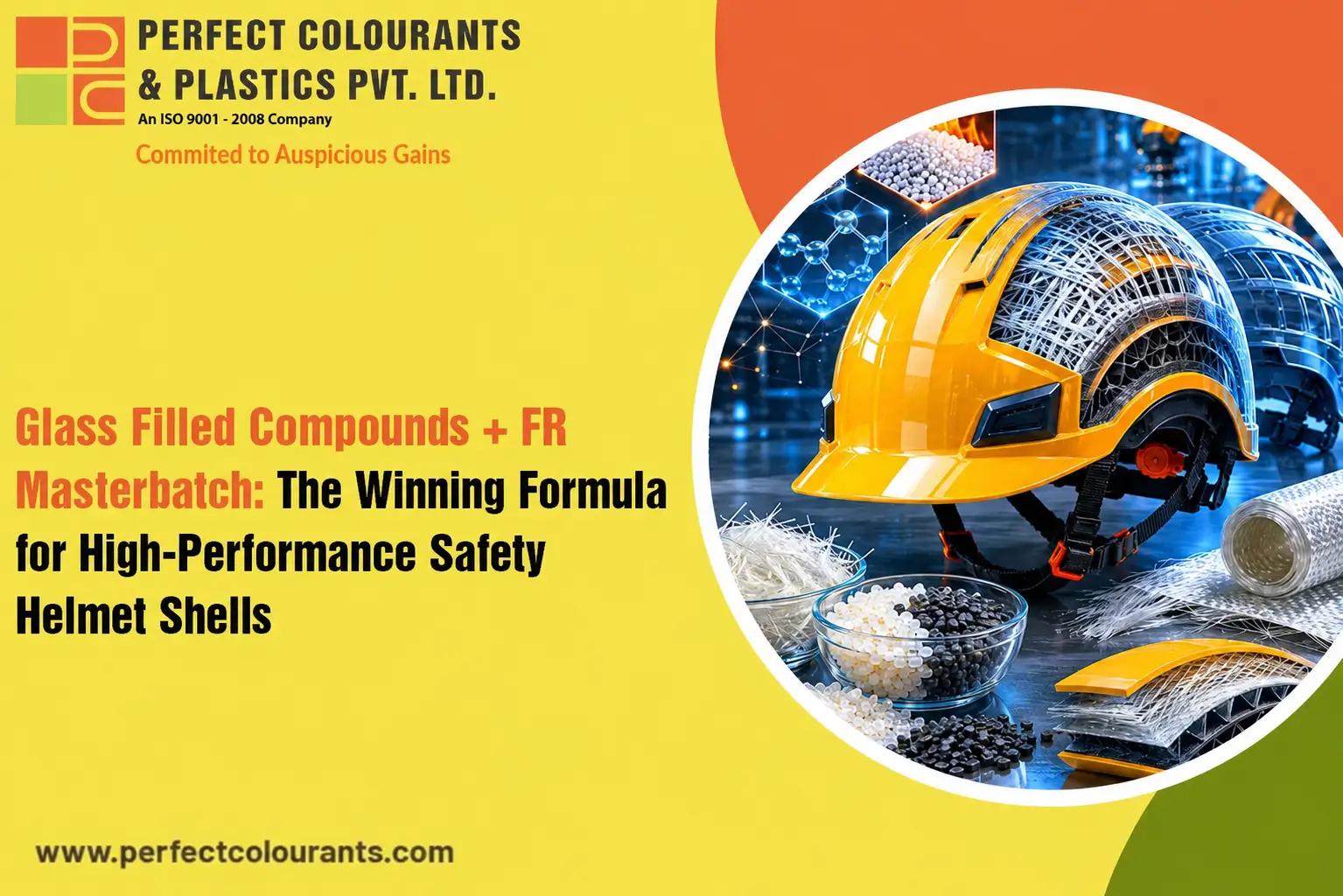
Glass Filled Compounds + FR Masterbatch: The Winning Formula for High-Performance Safety Helmet Shells
In high-risk environments, from industrial fires, underground mines to electrical substations and rescue sites, safety helmets serve as a barrier between life and major accidents. The main engineering challenge for modern personal protective equipment (PPE) is designing helmet shells that are lightweight, impact-resistant, and thermally-resistant. To meet this challenge, equipment brands are now turning to masterbatch leaders for glass filled compounds paired with high-performance flame-retardant masterbatch. In this blog, we explore why this combined technology presents a winning formula for next-generation safety helmet shells.
Helmet Design Principles: Why Glass Fibre Compounds are Ideal for Heavy-duty Applications

To understand why material selection is so important, we must understand the physics of injury prevention. A helmet protects the wearer by managing the kinetic energy of an impact, hence reducing the rapid deceleration force transmitted to the head. When an object strikes a helmet or when a worker falls, the helmet manages energy through a layered architectural system. This is the outer shell that distributes the highly localized kinetic force of an impact over a broader surface; an inner layer that absorbs shock; and a retention system to keep the helmet stable on the head.
For the outer shell to perform its distributing force and resist penetration, the material must possess an optimal balance of stiffness and toughness. This is when brands turn to long glass filled compound manufacturer in India (LFT) for glass filled compounds for heavy-duty mechanical applications.
The Mechanical Power of Glass Filled Compounds
Glass filled compounds are composite materials that are created by embedding high-tensile long glass or short glass fibres into a thermoplastic resin matrix such as PA/Nylon, PC, PP or PBT. When dispersed into the polymer matrix, they upgrade the material's mechanical properties:
- Tensile & Flexural Strength: Glass fibre serves as a primary load-bearing element. The polymer matrix transfers applied stresses to the high-strength fibres, increasing the compound’s tensile and flexural strength. This prevents the helmet shell from cracking under the force of falling objects.
- Exceptional Impact Resistance & Toughness: Glass filled compounds introduce a complex network of microscopic boundaries that obstruct crack propagation. Under impact, cracks navigate around the stiff glass fibre, dissipating energy through ‘fibre pull-out’ and matrix shear. This mechanism ensures the shell absorbs massive impact energies without catastrophic failure.
- Superior Dimensional Stability: The inclusion of glass fibre restricts molecular chain movement, providing exceptional stability. This ensures the helmet maintains its structural shape in varying temperatures.
- Durability & Lightweight: Glass filled compounds offer a strength-to-weight ratio that is comparable to structural materials like steel or aluminium, but at a fraction of the mass. By utilizing glass filled compounds, safety helmet brands can manufacture thin-walled, lightweight helmet shells that provide superior protection without causing neck strain.
High-Performance Fire Retardant Masterbatch for Fire Safety Shield
While the glass filled compounds provide the structural skeleton of the helmet shell, it does not protect the polymer matrix from thermal degradation. Thermoplastics are organic molecules that will ignite, melt and drip when exposed to direct flames or high radiant heat. This is where flame retardant masterbatch becomes a saviour. An FR masterbatch modifies the combustion chemistry of the helmet shell by:
- Slowing Down Combustion: Chemical additives release free radicals that interrupt the chemical chain reaction of the flame, delaying ignition and slowing down burn rate.
- Reducing Flame Spread: In a direct flashover, the FR compounds limit the propagation of flames across the helmet’s surface, preventing fire from destroying the safety gear.
- Suppressing Smoke & Preventing Dripping: High-quality FR masterbatch promotes char formation, creating a carbonaceous barrier that seals the underlying polymer, suppresses the smoke, and prevents dangerous dripping.
However, formulators often face the problem of heavy addition of FR that can weaken a polymer’s mechanical properties, making it brittle. This is why an industry-leading flame retardant masterbatch manufacturer in India offers highly dispersible MBs. Our custom formulations ensure excellent compatibility with the base resin and a precise mechanical bond between the polymer matrix and glass filled compounds. We offer both high-efficiency halogenated formulations and 100% non-halogenated phosphorus and nitrogen-based FRs.
The Winning Formula for High-Performance Safety Helmet Shells: Glass Filled Compunds & FRs
When manufacturers combines glass filled compounds with advanced FR masterbatch, they can truly unlock a winning formula. Individually, glass filled compounds provide mechanical strength, and FR masterbatches provide thermal protection. Together, they form a co-dependent, high-performance composite shield.
- Barrier Enhancement: When exposed to high heat, the flame retardant additives swell and char, while the embedded glass acts as a physical reinforcement network for the char layer. This prevents the char from eroding under thermal turbulence, maintaining a highly insulating fire barrier.
- Thermal Creep Resistance Under Flame: Under intense heat, standard polymers soften and deform rapidly. The combination of glass filled compounds and FR technology ensures the shell retains its shape and structural integrity even under direct exposure to flame, ensuring the critical air gap between the outer shell and the wearer’s head remains safe.
- Melt-drip Prevention: The glass filled compound acts as a mechanical mesh that traps softening polymer, with its anti-dripping mechanism of FR masterbatch to eliminate the risk of molten polymer dripping onto the worker.
When human lives are at risk, there is no room for safety compromise in safety equipment design. Combining glass-filled compounds with advanced FR masterbatch delivers the ultimate material solution for safety helmet shells. We also supply white and black masterbatch, liquid masterbatch and UV masterbatch for heavy-duty applications. Elevate your safety helmet line to meet the highest global standards with PCPPL. Contact us to discuss your plastic requirements.