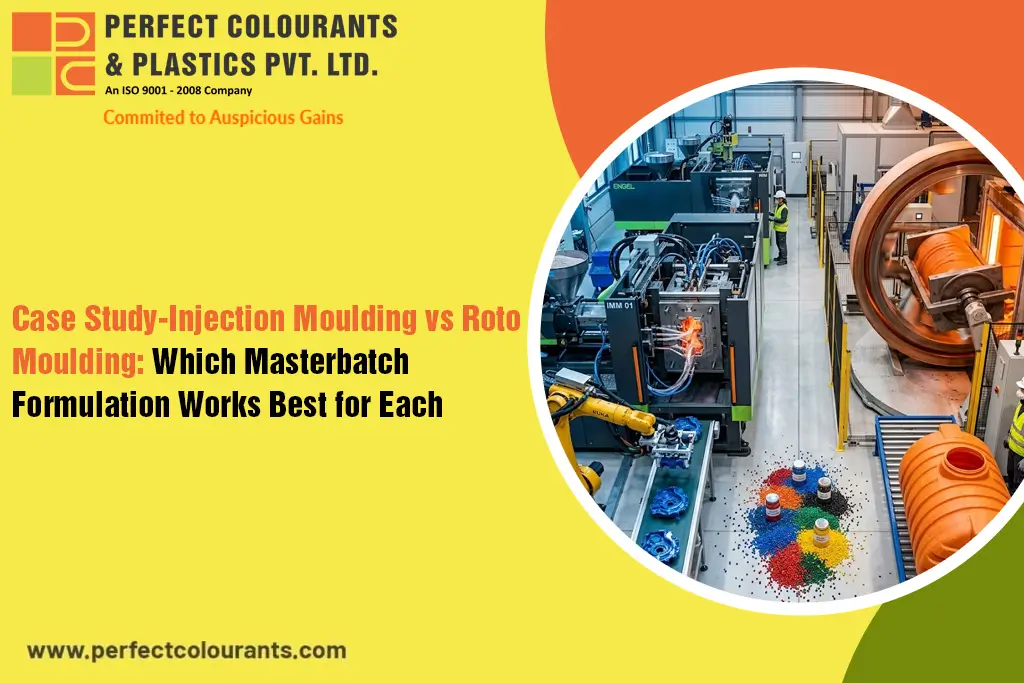
Injection Moulding vs Roto Moulding: Which Masterbatch Formulation Works Best for Each?
There are many plastic manufacturing techniques that turn raw thermoplastic into high-performance plastic products. Injection moulding and roto moulding are two of the most popular techniques. Both these production lines use the same base polymer and add colour masterbatch, but the end products are different. An injection moulding press produces thousands of bottle caps per hour, while a rotational moulding oven produces 1,000 litre water tanks at a few units per cycle. The masterbatch needs of each of these processes are different. Yet one of the most common and costly manufacturing mistakes people make is treating masterbatch as a generic input and assuming a colour or additive that works perfectly fine on an injection moulding press will perform equally well in a roto moulding oven.
The result? Colour streaking, poor dispersion, UV degradation, impact failure and some parts might come out of the mould with faults. With this case study, we at Perfect Colourants & Plastics Pvt.Ltd explain how different processes might need different masterbatch formulations, helping manufacturers make informed decisions.
Understanding Injection Moulding Vs. Roto Moulding: Why Are They Different
At Perfect Colourants & Plastics Pvt.Ltd, India’s top masterbatch producer, we emphasize understanding each of these processes and how masterbatch works within the thermal and mechanical conditions of the process.
| Injection Moulding | Roto Moulding |
| Molten polymer is injected under high-pressure into a closed steel mould. | Polymer powder is placed in a hollow mould & the mould rotates biaxially in oven at 260-370 oC |
| Solidifies rapidly under pressure | Powder melts & coats inner walls uniformly |
| Part ejected in seconds to minutes and produces solid, dense, precise parts | Slow cooling produces large, hollow, seamless parts |
| High-volume continuous production | Low-to-medium volume production |
| Primary resins: PP, ABS, HDPE, PC, Nylon, POM | Primary resins: LLDPE, HDPE, MDPE, PP, PVC |
| Melt temperature: 180 - 320 °C | Oven temperature: 260 - 370 °C |
| Cycle time: 15 to 120 seconds | Cycle time: 20 to 45 minutes |
| Common products: caps, closures, automotive parts, toys, electronic housings | Common products: Water tanks, bins, kayaks, playground equipment, fuel tanks, road barriers |
From a masterbatch perspective, it's not just temperature; it is time at temperature. Injection moulding exposes the polymer to high melt temperatures for seconds, while roto moulding exposes the polymer to sustained oven heat for 20 to 45 minutes. This prolonged thermal exposure is the defining challenge for masterbatch formulation in roto moulding and explains why both processes require different masterbatch formulations.
Masterbatch for Injection Moulding: Key Requirements
Injection moulding is the most widely used plastic manufacturing process in the world. It operates under high pressure, high shear, and tight cycle times; the masterbatch should perform reliably under all three constraints.
- Carrier Resin Compatibility: The foundational rule of masterbatch for injection moulding is polymer-specific carrier resin selection. The carrier resin in the masterbatch must be fully compatible with the base polymer being processed. A PP-carrier masterbatch in an ABS part or an LDPE carrier in a PC part can cause interface compatibility, poor dispersion and mechanical property degradation. Common carrier resins for injection moulding masterbatches include PP (for polypropylene applications, HDPE and LLDPE (for PE applications), ABS compatible carriers for ABS and HIPS applications and specialized carriers for engineering polymers like PC, Nylon, POM and PBT.
- Melt Flow Index (MFI) Matching: Injection moulding operates under high shear and injection pressure. The masterbatch must disperse rapidly and uniformly as it is pushed through the screw, heated barrel, and injected into the mould cavity into mould cavity. A masterbatch with an MFI significantly lower than the base resin creates a viscosity mismatch, resulting in streaking, weld lines and uneven colour distribution.
- Pigment Dispersion Quality: In injection moulding, pigment agglomerates, which clump undispersed pigment particles, create visual defects on the finished surface and can become stress points. High-quality, experienced colour masterbatch manufacturers in India are produced using two-screw compounding with intensive mixing elements, achieving particle sizes typically below one micron.
Additive Masterbatch for Injection Moulding
- Nucleating Masterbatch: Accelerates crystallisation in semi-crystalline polymers (PP, HDPE), reducing cycle time and improving dimensional stability
- Antiwarpage Masterbatch: Thin-walled injection moulded parts are highly prone to warpage as the polymer cools unevenly in the mould. Anti-warpage masterbatch improves dimensional stability and reduces scrap rates.
- Antiscratch Masterbatch: For visible, consumer-facing surfaces like luggage shells, automotive interiors, and electronic housings, scratch resistance is critical. PCPPL's antiscratch masterbatch reduces the surface coefficient of friction and improves hardness.
- Antistatic Masterbatch: Electronics housings, packaging components, and automotive interior parts often require ESD (electrostatic discharge) protection. Migratory or permanent antistatic masterbatch can be selected based on the duration of antistatic performance required.
- Flame Retardant Masterbatch: For electronics components, automotive parts, and building materials requiring UL94 compliance, PCPPL offers halogen-free flame retardant masterbatches that do not compromise mechanical properties.
- Flow Enhancer Masterbatch: For complex, thin-walled moulds with long flow paths, a flow enhancer masterbatch reduces melt viscosity and improves cavity fill, reducing injection pressure requirements and cycle time.
Masterbatch for Roto Moulding
Rotational moulding is one of the most demanding processes for masterbatch. Most manufacturers get it wrong, causing irreversible failures.
Roto Moulding Thermal Challenge
In a rotational moulding oven, the mould, loaded with polymer powder, rotates on two perpendicular axes while being heated at temperatures between 260OC and 370OC for 20 to 45 minutes. The polymer powder slowly melts, flows and coats the interior of the mould, building up wall thickness through successive layers. Every compound, every additive and every component of masterbatch should remain chemically and thermally stable throughout the cycle.
Dry Pigments Vs. Masterbatch
Rotational moulding has traditionally used dry pigments mixed directly with the polymer before loading the mould. This dry-blend approach allows the pigments to coat the powder particles and disperse as the polymer melts. However, dry blending introduces dust, handling challenges and pigment loading constraints. On the other hand, masterbatch pellets are specially formulated with LLDPE-compatible and heat-stable pigments. They offer better handling, more consistent dosing and the ability to incorporate multiple additives (for example, colour + UV + antioxidant) in a single pre-blended product.
Additive Masterbatch for Roto Moulding
- UV Masterbatch (HALS-based): This is the single most important additive for roto moulded products. Water tanks, playground equipment, bins, road barriers, and fuel tanks are all primarily outdoor products exposed to intense sunlight over the years of service. PCPPL's HALS (Hindered Amine Light Stabiliser) based UV masterbatches provide sustained UV protection for roto moulded LLDPE and HDPE products, preventing colour fading, surface chalking, and polymer chain degradation.
- Antioxidant Masterbatch: The prolonged oven heat of roto moulding causes thermal oxidation of the polymer, degrading mechanical properties and potentially causing colour shifts in the finished part. Antioxidant masterbatches combining primary antioxidants (radical scavengers) and secondary antioxidants (hydroperoxide decomposers) are standard inclusions in roto moulding formulations, particularly for parts with thick walls requiring long oven cycles.
- Impact Modifier Masterbatch: Large roto moulded parts like bins, tanks, and barriers face significant impact loads in service. An impact modifier masterbatch can substantially improve the low-temperature and ambient-temperature impact performance of LLDPE parts, critical for products used outdoors in variable climates.
- Antibacterial Masterbatch: For potable water tanks and food-grade storage vessels, PCPPL's antibacterial masterbatch inhibits biofilm formation and bacterial growth on the inner surface, meeting food and water safety standards without affecting the mechanical performance of the part.
- Antistatic Masterbatch (Permanent): For chemical storage tanks and fuel tanks made by roto moulding, a permanent antistatic masterbatch is critical, not a migratory antistatic. Permanent antistatic creates a conductive network within the polymer matrix that dissipates electrostatic charge without degrading over time, essential for storing flammable liquids safely.
- Antialgae Masterbatch: Agricultural and municipal water storage tanks are prone to algae growth, particularly in warm climates. PCPPL's anti-algae masterbatch incorporates biocidal agents that inhibit algal growth on tank surfaces, extending service life and maintaining water quality.
Wrapping Up
Injection moulding and roto moulding are two of the most important plastic manufacturing processes in India and globally. They produce the caps for your water bottle and the tank that stores your water. The automotive part and the road barrier. The toy and the playground. But they are as different in their masterbatch requirements as they are in their product outputs. Injection moulding demands high-MFI, polymer-specific carrier resins, sub-micron pigment dispersion, and process-specific additive masterbatches for nucleation, warpage control, and surface performance. Roto moulding demands heat-stable pigments, LLDPE-compatible carriers, roto-specific form factors, and a layered additive approach built around UV stabilisation and antioxidant protection as non-negotiables.
PCPPL has been providing exactly this level of technical depth and formulation expertise to injection moulders and roto moulders across India and the globe for over 3 decades. Whatever your process, whatever your polymer, and whatever your product, we have the masterbatch and the technical team to get it right. To discuss your requirements, call us today.