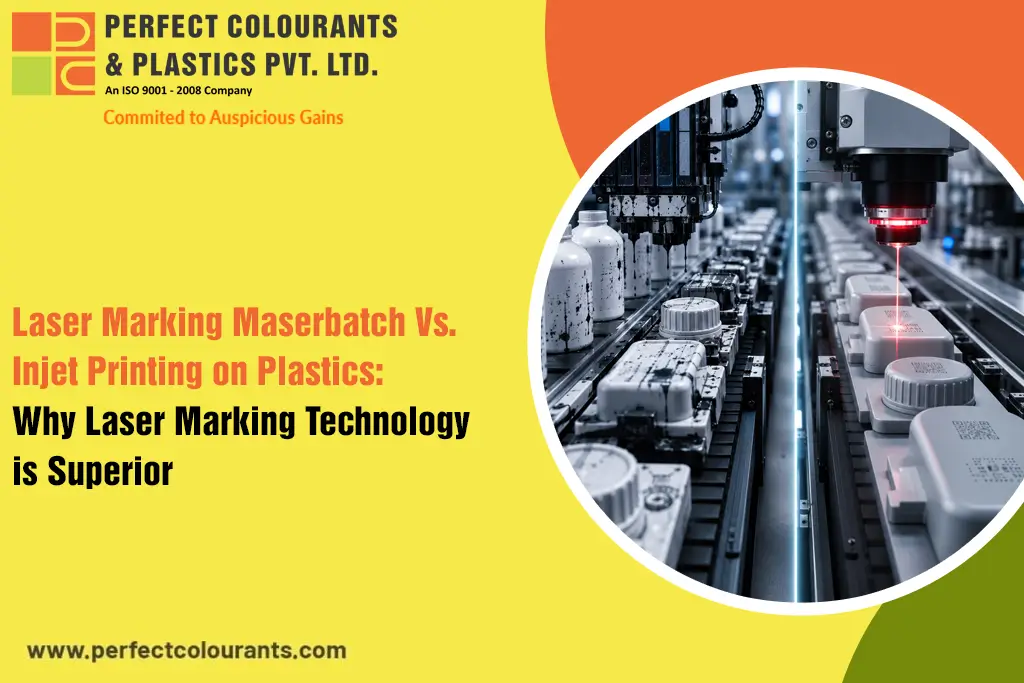
Laser Marking Maserbatch Vs. Injet Printing on Plastics: Why Laser Marking Technology is Superior
Product identification on plastics plays a crucial role in the manufacturing industry. From brand identity, traceability, quality control to regulatory compliance, plastic components carry vital information. Two of the most popular marking technologies are laser marking masterbatch and inkjet printing. These technologies are widely used to mark plastics like ABS, PC, PE, PP, PET, PA, TPU, POM, PBT and other polymer systems. In this guide, we compare laser marking vs. injet printing on plastics to optimize your production.
Laser Marking Maserbatch Vs. Injet Printing on Plastics: Two Ways to Mark Plastics
Every plastic component leaves the production facility with information carrying batch numbers, date codes, part numbers, logos, safety symbols, barcodes, QR codes or traceability data. For decades, continuous inkjet (CIJ) printing was the most prominent method for applying these marks. Ink droplets are sprayed into the plastic surface through high-speed ink formulations. A laser marking masterbatch takes a fundamentally different approach. Instead of applying on the surface, a laser beam triggers a controlled colour-change reaction within the polymer itself. To produce a high-contrast mark on the plastic, the right laser-sensitive additives are needed. This is exactly what we at Perfect Colourants & Plastics Pvt.Ltd, as a leading masterbatch producer in India, provides. A laser marking masterbatch is compounded into the polymer at a low dosage to create permanent markings on plastics.
Challenges Faced with Injet Printing on Plastics
Inkjet printing offers lower upfront costs and is widely used due to its durability, operating efficiency and long-term ROI. But plastics are among the most difficult substrates for ink adhesion, and producers face the following issues:
- Marks Sit On the Surface: Ink can be smudged before it dries, or scratched off in handling and dissolved by oils, fuels, cleaning agents and solvents.
- Fading Over Time: UV exposure, abrasion and weathering steadily degrade printing codes.
- Endless Consumables: Inks, solvents, makeup fluids and printhead spares are permanent operating costs.
- Environmental & Safety Concerns: Most CIJ inks are solvent-based, releasing VOCs into the workplace and creating hazardous waste streams.
- Counterfeiting Risks: A printed mark can be removed with solvent and reprinted. For security seals, ID tags and branded components, this can be a security issue.
How Laser Marking Masterbatch Solves These Challenges
A laser marking masterbatch is compounded into the polymer during extrusion or injection molding at a typical 2-3% dosage. When the laser fires, the additive absorbs the beam’s energy and triggers a controlled reaction.
- Carbonisation (Charring): Localised heating darkens the polymer, producing crisp dark marks on light or transparent plastics.
- Foaming: The laser creates microscopic gas bubbles that scatter light, producing bright light marks on dark plastics.
As a leading laser marking masterbatches manufacturer in India, we offer black and white laser marking masterbatches that care compatabile with fiber, UV and carbon lasers. It is water-proof, abrasion-resistant, heat-resistant and immune to solvents and oils.
Laser Marking Maserbatch Vs. Inkjet Printing: Side-by-side Comparison
| Parameter | Laser Marking Masterbatch | Injet Printing (CIJ) |
| Permanence | A permanent mark is created inside the polymer surface | Surface-level ink; can smudge, scratch, fade or dissolve |
| Chemical Resistance | Resistant to solvents, oils, fuels & cleaning agents | Many inks dissolve or soften on solvent contact |
| Consumables | None, no inks, solvents or makeup fluids | Continuous ink & solvent purchases, printed head wear |
| Maintenance & downtime | Minimal, no nozzles to clog, no fluids to change | Regular printed cleaning, nozzle clogging, fluid top-ups |
| Mark Quality | Sharp, high-resolution text, logos, barcodes & QR codes | Dot-matrix appearance; resolution limited by droplet size |
| Contrast Control | White-on-black & black-on-white via dedicated masterbatch grades | Contrast depends on ink adhesion & substrate colour |
| Anti-counterfeiting | Cannot be removed or altered without destroying the part | Can be solvent-wiped and reprinted |
| Environment & Safety | No VOCs, no hazardous ink waste | Solvent-based inks release VOCs, hazardous waste disposal |
White & Black Masterbatch on Dark Colour Plastics
Black and dark coloured plastic components dominate automotive interiors, electrical housings, cables and connectors. These MBs are the perfect solution where inject struggles because dark surfaces demand highly pigmented white inks.
White Masterbatch provides:
- High-contrast white text, logos & data-matrix codes on black parts
- Ideal for automotive components, wires & cables, connectors & dark electronic housings
- Marks remain scannable and legible for the full service life of the part
- Compatible with fiber, Nd:YAG & vanadate lasers at low dosage
Similarly, white medical devices, natural polyolefin containers, light-coloured pipes and fittings and transparent packaging all have the same problem; without an absorber, most polymers barely respond to laser wavelengths. A black laser marking masterbatch concentrates the laser energy into a clean carbonisation reaction, producing sharp, deep black marks on white, light-coloured, and transparent plastics.
- Jet-black codes, batch numbers & branding on white or natural substrates
- Perfect for medical equipment, pharma packaging, pipes & light appliances
- Sharper and far more durable than dot-matrix inkjet codes on the same parts
- Faster marking speeds, the absorber lets the laser work at lower power
Applications Where Laser Marking Has Already Replaced Inkjet
Across industries, converters who once relied on inkjet coding have moved to laser-markable compounds.
- Automative: under-bonnet components, connectors, and interior parts exposed to heat, oils, and abrasion.
- Electrical & Electronics: appliance housings, switches, and connectors requiring permanent ratings and safety symbols.
- Wires, Cables & Pipes: continuous marking at high line speeds without ink drying constraints.
- Medical Equipment & Pharma: sterilisation-resistant, solvent-proof identification on devices and packaging.
- Security Tags, Seals & Cattle ID Tags: tamper-proof, counterfeit-resistant marks that cannot be wiped and reprinted.
- Barcodes & QR Codes: machine-readable traceability codes that stay scannable for decades.
Laser marking masterbatches deliver a permanent, high-contrast, tamper-proof mark with zero consumables, zero VOCs and minimal maintenance. With dedicated white and black MB grades, PCPPL is the top laser marking masterbatch supplier our MBs are the perfect replacement for inkjet printing. Ready to move beyond ink? Call us today for high-performance MBs.
FAQs
1. Is laser marking better than inkjet printing on plastics?
➤ Yes, for most industrial applications. Laser marking creates a permanent mark inside the plastic surface that cannot smudge, fade, or be wiped off, while inkjet deposits ink on top of the surface that degrades over time. Laser marking also eliminates inks, solvents, and printhead maintenance, reducing running costs significantly.
2. What does a white laser marking masterbatch do?
➤ It enables bright, high-contrast white or light marks on black and dark-coloured plastics through a controlled foaming reaction. This makes it ideal for dark automotive parts, cables, connectors, and electronic housings where inkjet white inks adhere poorly.
3. What does a black laser marking masterbatch do?
➤ It produces deep, sharp black marks on white, light-coloured, or transparent plastics via controlled carbonisation. It is the go-to solution for white medical devices, natural polyolefin containers, pipes, and light-coloured appliance parts that otherwise show poor laser contrast.
4. What is the recommended dosage of laser marking masterbatch?
➤ A typical dosage of 2–3% delivers optimal contrast in most polymers, including ABS, PP, PE, PS, and SAN. The exact loading is fine-tuned to your polymer, part colour, wall thickness, and laser system.