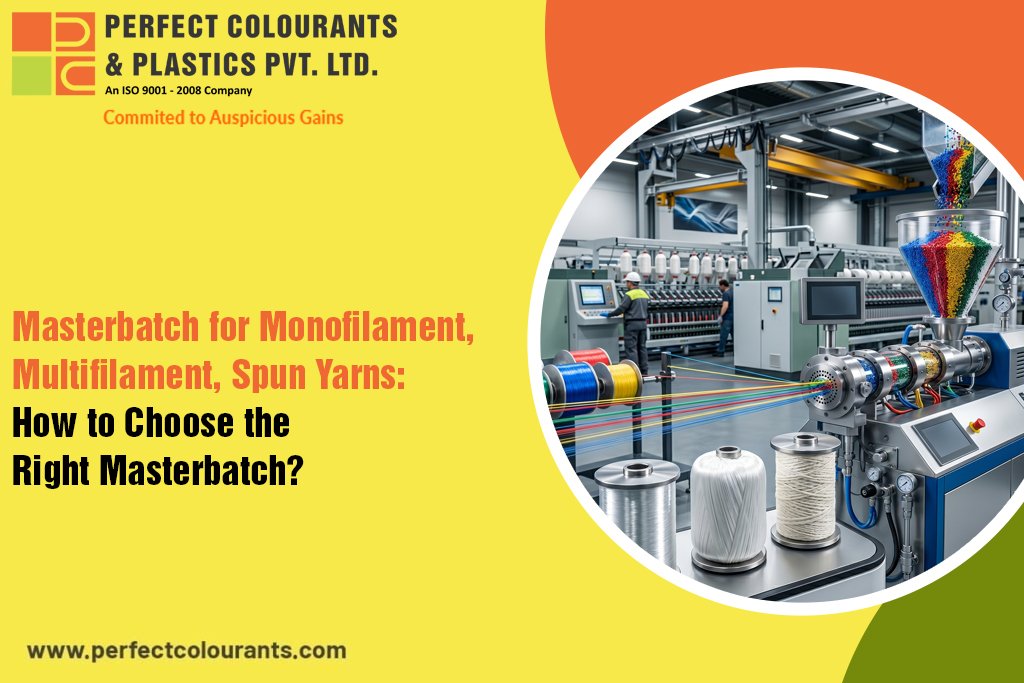
Masterbatch for Monofilament, Multifilament, Spun Yarns: How to Choose the Right Masterbatch?
In the world of synthetic fibres and yarn manufacturing, the masterbatch you choose is the processing ingredient that serves as a base. The wrong masterbatch can block spinnerets, cause filament breakage, degrade strength properties and can shut down spinning lines. The right MB ensures consistent colour, superior functional performance and cost-efficient processing. The main challenge is that monofilament, multifilament and spun yarn each subject the masterbatch to different shear, temperature and filtration conditions. Understanding this difference allows you to choose the right MB for your specific applications.
Masterbatch for Monofilament Yarn
A monofilament is a single, continuous strand extruded through a hole in a spinneret. The monofilament yarn is valued for its exceptional tensile strength, rigidity and dimensional stability. These textiles are widely used for shade nets, agricultural mesh, safety ropes and technical woven filters. Monofilament extrusion runs at high-draw ratios, as the melt is stretched significantly after leaving the spinneret. This amplifies any inconsistency in pigment dispersion, colour streaks and weak spots. Choose a masterbatch producer in India who offers masterbatch that must have ultra-fine, homogeneous pigment dispersion to survive this stretching without separation.
- Ultra Fine Pigment Particle Size: The MB should not have agglomerates that could cause spinneret blockage or filament breakage during high draw-ratio stretching.
- High Thermal Stability: Monofilament lines for HDPE and PP reach 230 to 270OC.
- Migration Resistance: Pigments must not bleed or surface migrate, especially in outdoor-use netting and geotextiles.
- UV Masterbatch: The UV masterbatch is strongly recommended for outdoor applications such as agricultural shade nets and safety barriers.
- Antistatic Masterbatch: The antistatic masterbatch is especially used in filtration mesh applications. It prevents dust attraction and static-related processing issues during high-speed winding.
Masterbatch for Multifilament Yarn
The multifilament yarn is spun by extruding polymer melt simultaneously through a spinneret with 30-100 holes. This creates a bundle of extremely fine individual filaments, typically 10-50 micrometres in diameter each. Masterbatch for multifilament must pass the tight filter pressure value (FPV) tests and achieve dispersion quality.
- Compatibility: The carrier resins must be completely compatible with the base polymer (PP carrier for PP yarn, PET carrier for polyester multifilament) to ensure seamless melt-mixing without viscosity mismatch.
- Uniform Dispersion: Pigment loading calibrated for the target let-down ratio without compromising dispersion quality.
- Optical Brightener Masterbatch: The optical brightener masterbatch is widely used in white and light shade multifilament yarn for POY, BCF and CF. It absorbs UV and re-emits visible blue light for brilliant whiteness.
- Antistatic Masterbatch: This MB controls static charge buildup during high-speed winding and prevents yarn-to-yarn adhesion.
Masterbatch for Spun Yarn
Spun yarn involves short-staple fibres twisted together to create a yarn. It may consist of spun yarn fibres that are natural (cotton, wool) or synthetic (polyester staple, PP, Nylon). In synthetic fibre spinning, masterbatch is added to the polymer melt in the product process.
Which Masterbatch for Which Yarn?
| Yarn Type | Recommended Masterbatch |
| Monofilament (PP, Nylon, HDPE) | Colour masterbatch, UV masterbatch, optical brightener, white masterbatch, antistatic masterbatch |
| Multifilament (PP, PET, Nylon) | Colour masterbatch, optical brightener, antistatic masterbatch, UV masterbatch |
| Spun Yarn (PP, PET) | Colour masterbatch, UV masterbatch, antistatic masterbatch, optical brightener, flame retardant |
Key Masterbatches for Yarn Spinning
At Perfect Colourants & Plastics Pvt.Ltd, as a top masterbatch manufacturer in India, we provide a comprehensive range of masterbatch and compounds used in yarn production.
- UV Masterbatch: HALS and UV-absorber-based formulations protect PP and PET yarns from photo oxidative degradation. It is essential for outdoor yarns in shade nets, geotextiles and ropes exposed to prolonged sunlight.
- Optical Brightener Masterbatch: The fluorescent whitening agents absorb UV and re-emit visible blue light. It delivers brilliant whiteness and brightness to white and pastel yarns in POY, CF and BCF applications.
- Cooling Masterbatch for PP: It reduces PP melt viscosity and processing temperature by 20-30 OC at 0.5-1% loading. The cooling masterbatch allows stable fine-denier spinning without pigment degradation, improves melt flow index and increases production throughput.
- Antistatic Masterbatch: Dissipates static charge build-up during high-speed winding and twisting of synthetic yarns. The antistatic MB prevents yarn-to-yarn sticking, dust contamination and processing disturbances on winding equipment.
Why Cooling Masterbatch is a Game Changer in PP Yarn Spinning?
Polypropylene is the main polymer in the yarn spinning industry. It is affordable, chemically resistant and highly versatile. But its high melt viscosity at standard processing temperature creates a genuine challenge, which is: excessive heat degrades pigment, damages processing additives and limits the fineness of filaments.
At PPCPL, as the leading cooling masterbatch manufacturer in India, our cooling masterbatch for PP addresses this challenge directly. It reduces the processing temperature of PP by 20-30 OC, simultaneously increasing the melt flow index. This allows for stable extrusion at lower temperatures, better colour and reduced power consumption.
Conclusion
Monofilament, multifilament and spun yarn each has unique masterbatch demands. At PPCPL, we manufacture a full range of masterbatches, including colour, UV, antistatic, optical brightener, cooling, and other MBs, especially formulated for PP, PET and Nylon yarn applications. Find the right masterbatch for your yarn with PPCPL. To request quotes, call us today.