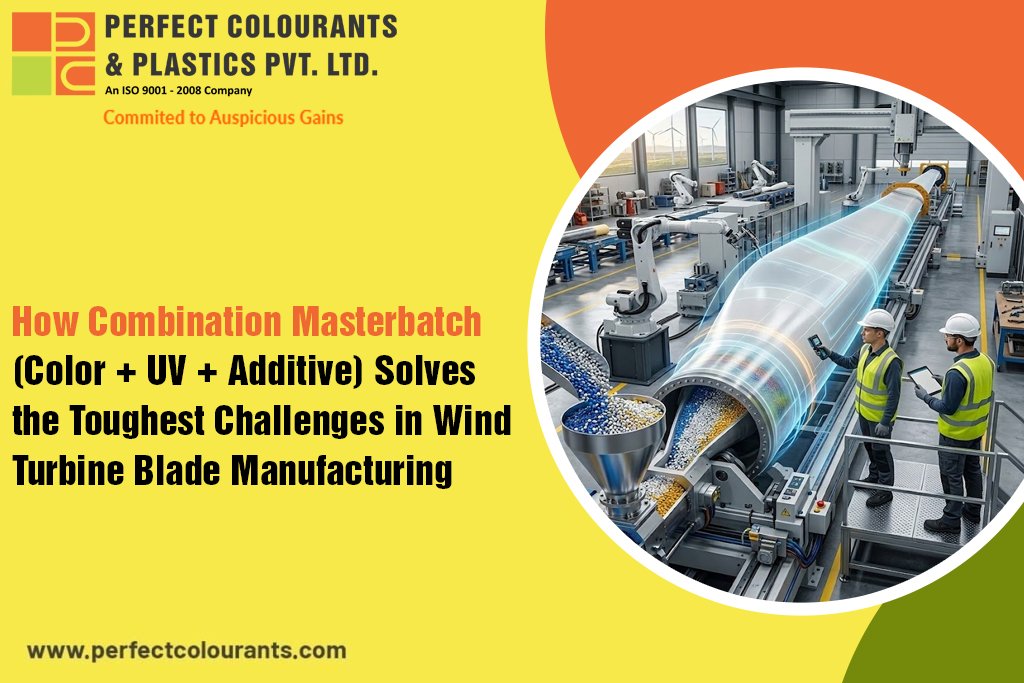
How Combination Masterbatch (Colour + UV + Additive) Solves the Toughest Challenges in Wind Turbine Blade Manufacturing
India just recorded its highest-ever annual wind energy capacity addition, 6.1 GW in FY 2025-26. With a cumulative 56 GW installed and a target of 100 GW in 2025, wind turbine manufacturers and blade OEMs are scaling production at a pace that meets demands with smarter, more reliable material solutions. Every blade deployed must survive 20 to 25 years of UV radiation, monsoon humidity, thermal cycling and high-speed particulate erosion often simultaneously.
At the centre of the blade’s polymer protection strategy is the TPU (Thermoplastic Polyurethane) leading-edge sheet, which is extruded into the blade surface. The masterbatch loaded into this TPU determines whether the blade holds colour, resists UV-induced embrittlement, withstands moisture-driven hydrolysis and survives high-temperature extrusion without discolouration. In this blog, we break down 5 critical challenges the TPU blade must overcome and how Perfect Colourants & Plastics Pvt.Ltd (PCPPL), a leading master batch company in India, our combination masterbatch approach (colour masterbatch + UV masterbatch + antioxidant masterbatch) is engineered as a single compatible system to address each challenge with precision.
5 Material Challenges That Make Blade Made of TPU One of Most Challenging Applications in Polymer Processing
#1 UV-A & UV-B Radiation Stability
Wind turbines operate outdoors for 20+ years. The TPU sheets absorb UV-A and UV-B radiation continuously. Without stabilization, UV energy breaks the polymer chain bonds, causing chalking, surface cracking, loss of mechanical strength and colour fading that accelerates erosion. This causes chalking, loss of mechanical strength and colour fading that accelerates erosion.
#2 Anti-yellowing for White & Light-grey Blades
Industry-standard blade colours are white (RAL 9003/9016) and light grey (RAL 7035). Both these are accurately sensitive to yellowing caused by oxidative degradation and UV exposure. A yellowed blade signals degradation to end-users and violates strict visual acceptance standards for OEMs.
#3 Hydrolysis Resistance
TPU is susceptible to hydrolysis chain scission in the presence of moisture. This is a major concern in coastal and offshore and high-rainfall environments like India’s western coats and Tamil Nadu. Hydrolysis degrades molecular weight, reduces tensile strength and causes delamination of protective sheet from the blade substrate.
#4 High-temperature Extrusion
TPU sheet extrusion runs at 180 to 220-degree celsius. At these temperatures, certain colourants oxidise, pigments migrate or additives volatilise causing discolouration (especially visible in white/grey light), surface defects and inconsistent additive distribution throughout the sheet.
#5 Erosion Resistance & Adhesive Reliability
Blade tips travel at 80-100 m/s. Rain droplets, dust and particulate matter strike the leading edge with high-energy impacts throughout service life. The protective TPU sheet must maintain adhesive reliability, chemical stability and resistance to progressive surface erosion under these conditions.
PCPPL’s Combination Masterbatch: Three Layers One Solution
As a leader in masterbatch technology, our MBs are engineered for wind blade TPU applications. Our three complementary additive systems work synergistically in the same carrier matrix.
#1 UV Masterbatch: Long-term UV-A & UV-B Stabilization without Yellowing or Cracking
PCPPL’s UV masterbatch for TPU blade applications combines Hindered Amine Light Stabilizers (HALS) with UV absorbers (UVA) is a dual-mechanism protection system. HALS function by scavenging free radicals generated by UV exposure, providing long-term, non-consumable protection. UVAs absorb UV radiation and dissipate it harmlessly as heat. Together they protect the polymer matrix across both UV-A and UV-B spectra, maintaining surface integrity and preventing chalking, pitting and colour shift.
#2 Colour Masterbatch: Heat Stable, Anti-yellowing & Light-yellow for OEM Colours
White and light-grey blade colours must match OEM RAL standard precisely. These colours need to hold upto 20+ years under outdoor conditions. PCPPL’s colour masterbatch for this application uses inorganic pigments systems (primarily titanium dioxide in ultrafine grades for white. They are carefully selected inorganic pigments combination for grey specifically for their UV stability, non-blooming behaviour in TPU and resistance to discolouration at extrusion temperatures. Anti -yellowing additives are co-formulated into the colour system not added separately to ensure they act precisely where the colour change would otherwise occur.
#3 Antioxidant Masterbatch: Thermal Stability During Processing & Hydrolysis Resistance
Oxidative degradation occurs at two critical points: during high-temperature extrusion (processing stabilization) and during long-term outdoor service (long-term stabilization). PCPPL’s antioxidant masterbatch addresses both with a primary/secondary antioxidant pairing- primary antioxidants (hindered phenolics) interrupt chain-reaction oxidation, while secondary antioxidants (phosphites) decompose hyperoxide before they trigger further damage. This approach also provides meaningful hydrolysis resistance by reducing the oxidative load that accelerates moisture induced chain scission in TPU’s ester or ether segments.
Why PCPPL is the Right Masterbatch Partner for Wind Energy Applications?
Choosing a masterbatch supplier in India for a safety -critical renewable energy applications is not a commodity decision. Here is PCPPL brings specifically to wind turbine blade manufacturers.
- Formulation Depth Across All 3 Functions: PCPPL manufactures UV MB, colour MB and antioxidant MB in-house enabling genuine co-formulation rather than simply sourcing and re-packing third-party additives.
- TPU-specific Carrier & Additive Selection: Not all UV stabilizers or antioxidants are compatible with TPU chemistry. PCPPL’s formulation team selects and carrier resins specifically validated for TPU extrusion.
- India-based Manufacturing, Globally Serving: Manufactured India proximity to India’s major wind manufacturing hubs in Gujarat, Tamil Nadu and Maharashtra. PCPPL is a leading masterbatch exporter, supporting international blade OEMs seeking cost-effective, high-quality Indian masterbatch supply.
- Custom-led Down Ratio Optimization: PCPPL works with blade manufacturers to optimise the let-down ratio of the combination system for their specific extrusion line parameters, TPU grade, and target performance specifications, not a one-size-fits-all dosing recommendation.
A wind turbine blade is one of the most demanding long-life polymer applications in existence. It must perform reliably for two decades outdoors, in environments ranging from India's coastal Tamil Nadu to Germany's North Sea, under UV radiation, moisture, temperature extremes, and mechanical stress. The TPU protective sheet that guards its leading edge must do the same.
PCPPL's approach co-developing UV Masterbatch, Colour Masterbatch, and Antioxidant Masterbatch as a single, TPU-validated combination system eliminates the compatibility risks and accountability gaps of multi-supplier approaches. It delivers a traceable, reproducible, technically supported solution from one manufacturer committed to the growing renewable energy sector. To discuss your blade OEM requirements, call us today.