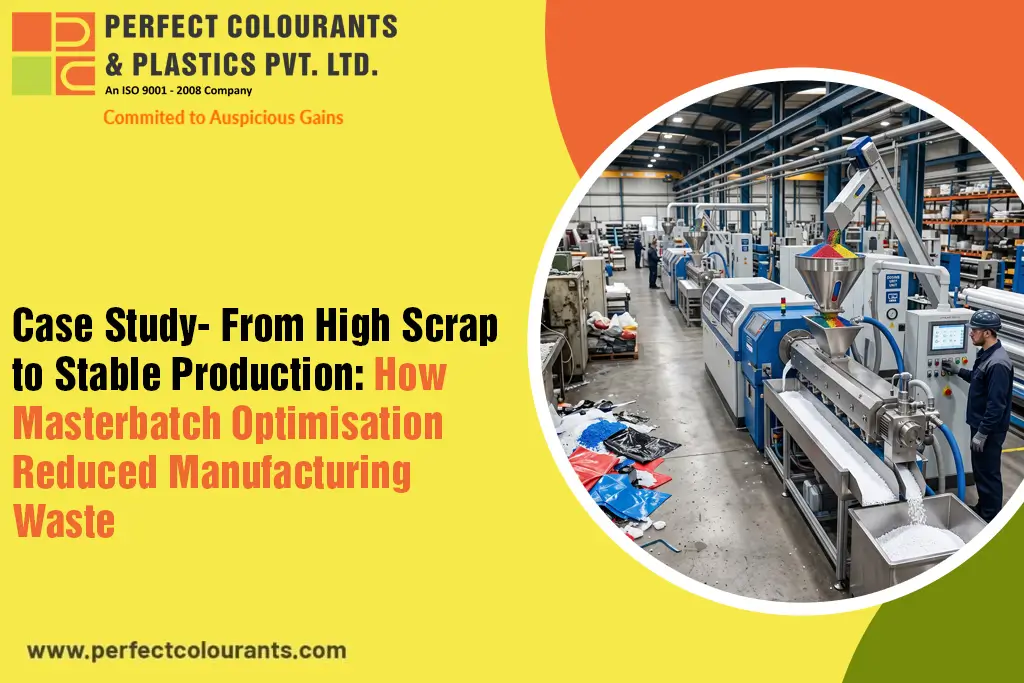
Case Study: From High Scrap to Stable Production: How Masterbatch Optimisation Reduced Manufacturing Waste
For plastic manufacturers, scrap is more than wasted material. Every rejected part also represents lost machine time, energy, labour and production capacity. When rejection continues over several production cycles, even a seemingly small processing issue can become a significant manufacturing cost.
This case study examines a production problem where a manufacturer faced high scrap rates due to inconsistent processing and unstable output. Perfect Colourants & Plastics Pvt. Ltd. Tackled the issue by going beyond the masterbatch. They looked at the picture- how the formulation, polymer and processing conditions worked together.
By understanding the connection between these elements they found a way to improve consistency and reduce waste.
The Problem: Rising Scrap During Production
The manufacturer was producing plastic components in regular production runs, but the output was not consistently meeting the required quality standards. Variation in processing resulted in rejected pieces, increasing material consumption and putting additional pressure on production efficiency.
The first assumption was that the problem could be solved by adjusting the dosage. Simply increasing or decreasing the masterbatch dosage without knowing why the product was being rejected could lead to more issues in processing.
So the investigation shifted focus. Looking only at the masterbatch the team examined the entire material-processing system.
Looking Beyond the Masterbatch
Masterbatch performance depends on more than its active ingredients. The base polymer, the carrier system, the dosage used, how well it disperses, the processing temperature and the machine settings all play a role in the outcome.
Because of this the production team looked at the formulation with the actual processing environment. They wanted to check if the masterbatch was truly compatible with the polymer and if the dosage was right, for the production conditions.
This step mattered a lot. A formulation that works well in one situation might not give the consistent results if the polymer grade changes or if machine settings are adjusted or if other processing parameters shift.
Identifying the Processing Issue
Once the production data was reviewed, attention shifted towards processing consistency. Variations in how the material melts were making it hard to keep the output during the whole production run.
By changing the whole polymer system the manufacturer looked into whether a functional masterbatch could handle the processing needs in a better way.
This is when Plastic Processing AID Masterbatches can help. They are made for situations where smoother processing, better melt behavior or a better surface finish is needed. The goal is not just to add something but to help the current material system and make the processing more steady.
Optimising the Formulation
The next stage involved controlled trials. Different dosage levels were evaluated while observing processing behaviour and product quality.
The trials focused on a simple question: What is the lowest effective dosage that delivers the required processing improvement without creating new problems? Perfect Colourants & Plastics Pvt. Ltd. used this application-focused approach to evaluate the formulation against the actual production requirements rather than relying on a standard dosage.
This is a part of optimizing masterbatch. If there is no additive it might not do what is needed but if there is too much it can affect how things are processed, how they look, how strong they are or how much the whole mix costs.
When there are differences in how the melt moves that can be a big reason for changes during processing. In that case a Flow Enhancer Masterbatch might be tested as a way to fix the problem. The right amount to use depends on the type of polymer the machine and how it is used. The results have to be checked when the real work is happening.
From Trial Runs to Stable Production
After the mix was changed the production team watched what happened over runs instead of deciding if it worked after just one try.
They wanted to see if things stayed the same and if the number of products went down. Getting to production is important because a fix that works for a short time but causes problems later does not help in the long run.
This way of working also helped the manufacturer learn how the materials they choose connect with the machines they use. This led to a reliable production process instead of always making manual changes.
The Role of Targeted Functional Solutions
Not all problems with waste need the same answer. If the main issue is that things are not the right shape, for example, an Anti Warpage Masterbatch could be better than something that just helps with processing.
This shows an idea: choosing a masterbatch should start with the problem in manufacturing, not with looking at a list of products.
The same idea is useful when looking at types of additives. The manufacturer should first figure out what problem they are facing then decide if an additive can fix it without changing everything in the mix.
What Changed After Optimisation?
The biggest improvement was not simply a reduction in rejected products. A more stable process can provide several connected benefits:
➤ More consistent production output
➤ Better utilisation of raw materials
➤ Fewer avoidable rejects
➤ Reduced need for repeated process adjustments
➤ More predictable production cycles
➤ Improved consistency between batches
The main aim was to make the process more predictable. When production becomes steady manufacturers can cut down on waste while using the equipment and raw materials more effectively.
What Manufacturers Can Learn From This Case
This case shows why scrap reduction should start with finding the root cause of making quick changes to formulas.
A masterbatch should be chosen based on the polymer, the method used for processing the machine conditions and the performance needed at the end. Then the right amount should be decided through controlled tests and real production checks.
The bigger takeaway is that optimisation does not always mean making changes to the manufacturing setup. A better understanding of the material system and a picked solution can sometimes fix the reason for repeated waste more efficiently.
Turning Scrap Reduction Into Process Stability
High levels of scrap are usually a sign that a production process needs a look. By just accepting repeated rejection or constantly changing machine settings, manufacturers can look into how the polymer, masterbatch and processing conditions work together.
The correct optimisation strategy can help make the process more consistent, cut down on waste and make production more predictable.
For manufacturers dealing with processing problems, Perfect Colourants & Plastics Pvt. Ltd. offers solutions that focus on real applications based on specific material and production needs. As a master batch company in India, the company works to help processors get reliable performance, efficient production and better use of materials.