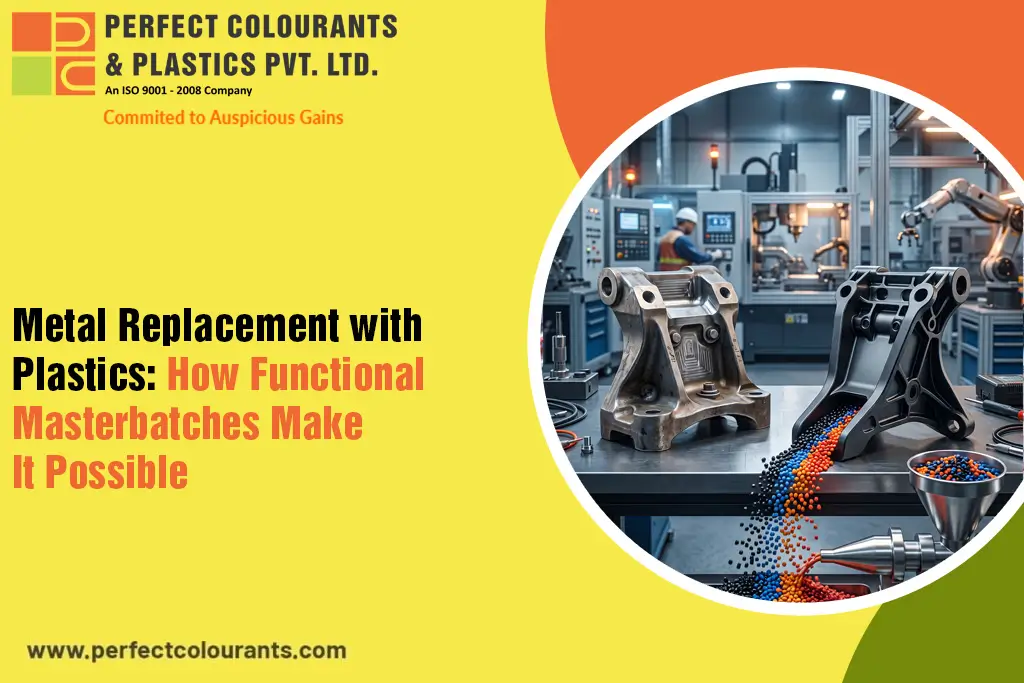
Metal Replacement with Plastics: How Functional Masterbatches Make It Possible
Metal has traditionally been used for parts that require strength, rigidity, durability and stable dimensions. Today manufacturers are seeking materials that can perform reliably while also providing better design options and easier processing. This has increased interest in replacing selected Metal Replacement components with Plastics.
The transition is not simply a matter of replacing one material with another. Plastics must be engineered to meet the requirements of the original Metal Replacement component. This is where Functional Masterbatches, reinforcement and advanced plastic compounds can make a difference.
How Do Functional Masterbatches Support Metal Replacement?
Functional Masterbatches are formulations designed to add properties to a polymer.
Functional Masterbatches can change characteristics like impact resistance, processing behaviour, surface performance, dimensional stability or resistance to conditions depending on the need. For example an Impact Modifier Masterbatch helps improve toughness and impact performance, in thermoplastics.
This can be useful where a plastic component needs to withstand stress or sudden loads. PCPPL’s multifunctional impact modifier is designed to improve toughness, impact resistance and durability while balancing properties such as stiffness, heat resistance and processing efficiency.
Functional additives do not make every plastic suitable for metal replacement. Instead, they help manufacturers fine‑tune a polymer system so that it better matches the performance requirements of an application.
The Role of Glass‑Filled Compounds
For demanding Metal Replacement applications, reinforcement can be more important than additives alone. Glass fibres can significantly improve the stiffness, strength and dimensional stability of thermoplastics.
➤ Long Glass‑Filled Compound (LFT) Solutions use glass fibres to reinforce the polymer matrix. PCPPL describes its glass‑filled compounds as Metal Replacement solutions for automotive and industrial applications with improvements in stiffness, strength and impact resistance.
➤ Short Glass‑Filled Compound Solutions use fibres and can provide a useful balance of strength, rigidity, impact resistance and processability. PCPPL offers glass‑filled compounds for demanding applications, including automotive components with options across several polymer systems.
The choice between long‑ and short‑fibre reinforcement depends on the component design, required properties, processing method and application conditions.
Which Functional Properties Matter?
Successful Metal Replacement requires manufacturers to consider the performance profile of the component rather than focusing on strength alone.
1. Impact Resistance
Components exposed to shocks or sudden loads need toughness. Impact modifiers can help improve resistance to cracking or damage under demanding conditions.
2. Stability
A replacement plastic component must retain its shape and dimensions during use. Anti Warpage Masterbatch can help reduce shrinkage and warpage in thermoplastic applications supporting better dimensional stability.
3. Surface Durability
Metal components often provide good surface hardness. Wear resistance. Depending on the application additives such as an Abrasion Resistance Masterbatch or scratch‑resistant formulation may help improve the durability of surfaces.
4. Environmental Resistance
Components exposed to sunlight, heat or other environmental conditions may require protection. Functional solutions such as UV Masterbatch can be considered where UV exposure is a performance factor.
Metal Replacement Is Also About Design
Changing the material without changing the component design is not always the approach. Plastics and metals behave differently under load, temperature and long‑term stress.
A successful conversion may require changes to wall thickness, ribs, bosses, fastening points and load paths. Material selection and component design therefore need to be evaluated. Industry guidance on Metal Replacement emphasizes that reinforced Plastics should be engineered around the load and application rather than treated as a direct one‑to‑one material swap.
This is particularly important, for electrical, industrial and appliance components where reliability is critical.
Where Can Metal Replacement Plastics Be Used?
Metal replacement plastics are being looked at in areas where lighter weight, flexible design and easy processing are important.
These include exterior parts, electrical parts, industrial parts, appliance parts, structural housings and other engineered products. PCPPL highlights glass-filled compounds for uses such as body modules, instrument panels, mirrors, wiper arms and other parts.
Functional masterbatches can further support these uses by addressing needs such as impact performance, UV resistance, dimensional stability, processing behaviour or surface durability.
Choosing the Right Masterbatch and Compound
There is no formula for replacing metal with plastics. The best solution depends on the design of the polymer part, the temperature it will work in, the force it will handle, the environment it will be in, the way it is made and how long it needs to last. Manufacturers should therefore look at the material system instead of picking a functional additive based on just one feature. The level of reinforcement, how things mix, color requirements and the way it is processed can all affect the final product.
Perfect Colourants & Plastics Pvt. Ltd. Offers compound solutions for applications that need better function and performance. Its stock includes glass-filled compounds and functional masterbatches that can be customized for each polymer and use.
The use of plastics of metal is becoming easier because special types of plastic ways to make them stronger and special ingredients added to them are all getting better. The goal is not just to make plastic stronger but to create a system of materials that has the balance of strength, rigidity, resistance, to break staying the same shape lasting a long time and being easy to work with.
Glass-filled compounds give reinforcement for structural uses while functional masterbatches can meet particular performance needs. When material choice, additives and component design go together metal replacement plastics can work well for uses. As a masterbatch company in India, Perfect Colourants & Plastics Pvt. Ltd. Can help makers pick masterbatch and compound solutions based on their needed polymer, performance and processing conditions.
FAQ’S
1) What is the process of plastic metallization?
Plastic metallization involves depositing a thin metal layer, usually aluminium, onto a prepared plastic surface to create a metallic appearance, reflectivity, or specific functional properties.
2) What material will replace plastic?
There is no single replacement for plastic. Depending on the application, glass, metal, paper, wood, ceramics, and biodegradable or bio-based materials can replace certain types of plastic.
3) What is the future of plastic?
The future of plastic is likely to focus on recyclability, lightweight materials, bio-based polymers, advanced additives, and high-performance plastics that offer better durability while reducing environmental impact.
4) What is cheap but strong plastic?
Polypropylene (PP) is a relatively low-cost plastic with good strength, chemical resistance and durability. For higher strength, glass-filled PP can provide improved stiffness and mechanical performance.