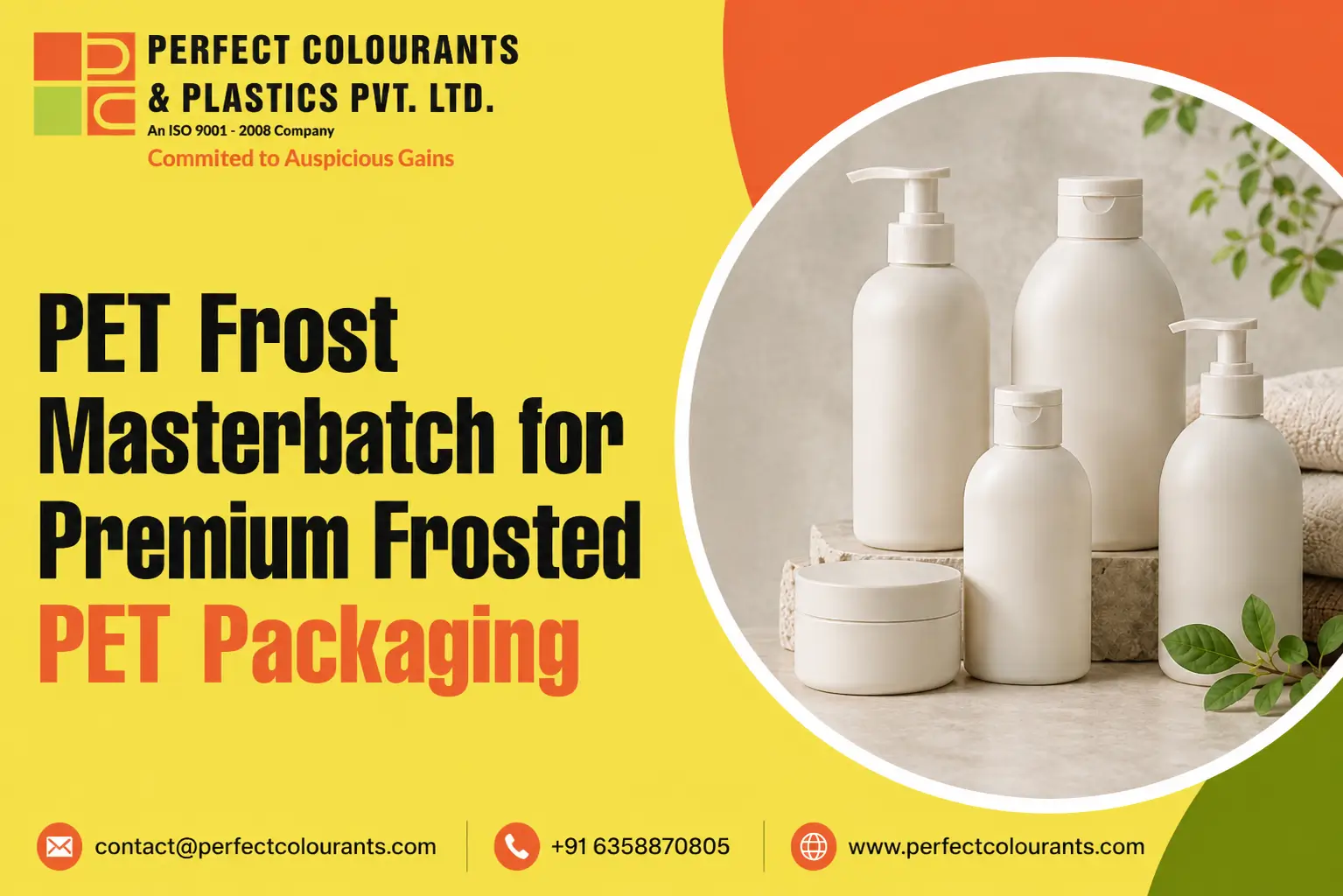
PET Frost Masterbatch for Premium Frosted PET Packaging
In today’s competitive packaging market, appearance is often as important as performance. PET is traditionally valued for its clarity, gloss and glass-like appearance. However, many brands are increasingly looking for a soft, elegant, semi-translucent and premium “frosted” appearance. PET Frost Masterbatch provides an efficient route to achieve this effect during PET processing.
What is the Frost Effect in PET?
The frost effect is a controlled reduction in visual clarity and surface gloss of PET, producing an appearance similar to frosted or etched glass. Instead of allowing light to pass through PET in a highly directional manner, the frost-effect system promotes controlled light diffusion and scattering.
Typical Visual Progression:
Clear → Soft Frost → Medium Frost → Heavy Frost / Opaque Matte
How Does PET Frost Masterbatch Work?
PET Frost Masterbatch contains a carefully selected effect-producing additive system dispersed in a PET-compatible carrier. During processing, the additive creates controlled differences in optical properties at a microscopic level. These differences cause incident light to scatter rather than travelling straight through the PET.
Simple Mechanism: Light → PET Surface → Controlled Scattering → Diffused Light → Frosted Appearance
The final effect depends on masterbatch dosage, PET grade, IV, processing temperature, stretch ratio, moulding conditions, wall thickness and dispersion quality.
Why Use PET Frost Masterbatch?
Conventional Approach | PET Frost Masterbatch |
May require secondary operation | Effect generated during moulding |
Spray/coating equipment may be required | No separate coating process |
Additional processing time | Integrated into production |
Mould texturing may be required | Can work with suitable existing tooling |
More process steps | Simpler process flow |
Coating uniformity can be critical | Effect controlled through formulation and dosage |
Key Benefits
➤ Premium and sophisticated appearance
➤ Frosted-glass / etched-glass visual effect
➤ Reduced surface gloss and contemporary matte finish
➤ Better concealment of fingerprints and smudges
➤ Strong opportunity for brand differentiation
➤ Potential for use in rPET packaging, subject to formulation validation
Applications
➤ Cosmetics & Personal Care: shampoo, lotion, serum and skin-care bottles
➤ Food & Beverage: premium and specialty beverage packaging
➤ Household Products: liquid cleaners and home-care packaging
➤ Industrial and Speciality Containers
Frost Effect vs. Matte Effect
Matte effect primarily focuses on reducing surface gloss, whereas frost effect generally aims to produce a more noticeable translucent, diffused or frosted-glass appearance. A product can therefore be low-gloss and transparent, or low-gloss, translucent and strongly frosted depending on the formulation.
How to Develop a PET Frost Masterbatch
1. PET-Compatible Carrier: Select a carrier suitable for the PET processing system and intended application.
2. Frost-Effect Additive: Use an effect system that provides controlled optical scattering without unacceptable impact on mechanical properties or processing.
3. Dispersion: Uniform dispersion is critical to avoid haze variation, spots, uneven frost, surface defects and screen-pack problems.
4. Processing Stability: The formulation should remain stable during PET processing without unacceptable degradation, colour shift or processing instability.
Recommended Development Approach
A dosage ladder is recommended rather than selecting a single dosage for every PET grade and application.
Trial | Relative Dosage | Expected Effect |
| 1 | Low | Slight haze / soft frost |
| 2 | Medium-Low | Light frost |
| 3 | Medium | Moderate frost |
| 4 | Medium-High | Strong frost |
| 5 | High | Heavy frost / matte |
Actual dosage should be established experimentally for the specific formulation, PET grade and application.
Important Evaluation Parameters
➤ Haze and total light transmittance
➤ Gloss
➤ Visual frost intensity and surface uniformity
➤ Colour / yellowness
➤ IV retention
➤ Tensile and other relevant mechanical properties
➤ Bottle appearance and processing stability
Processing Considerations
Moisture control remains critical because PET is sensitive to hydrolytic degradation during melt processing. Poor drying can lead to IV loss, reduced mechanical properties, acetaldehyde-related issues and appearance variation.
➤ Ensure uniform masterbatch mixing and dispersion.
➤ Optimise preform injection conditions for consistent distribution.
➤ Validate the effect during stretch blow moulding because stretch ratio, heating profile and blowing conditions can influence final appearance.
➤ Revalidate the dosage when changing PET grade, bottle design, wall thickness or processing equipment.
Frost + Colour: Creating a Distinctive Look
Frost Masterbatch can be combined with transparent colours to create distinctive visual identities. Examples include Frost + Light Blue for an icy appearance, Frost + Green for a botanical look, Frost + Amber for a glass-like premium appearance, and Frost + Pink or Violet for cosmetic packaging.
Frost Effect Without Changing the Mould
One of the commercial attractions of PET Masterbatch & PET Frost Masterbatch is the potential to introduce a premium frosted appearance without changing the mould surface. This can help brands create a new packaging variant while retaining an existing bottle platform, subject to application and process validation.
Conclusion
PET Frost Masterbatch is more than a simple matte additive. It is a technology for transforming conventional clear PET into a soft, elegant and premium-looking packaging material. By controlling additive selection, concentration, dispersion and processing conditions, manufacturers can develop anything from a subtle translucent frost to a strong frosted-glass appearance.
For cosmetic, personal-care, beverage and premium packaging, PET Frost Masterbatch offers an attractive alternative to conventional coating and mould-texturing techniques. Contact Perfect Colourants & Plastics Pvt.Ltd.
Clear PET Gives Transparency.
Frosted PET Gives Character.
PET Frost Masterbatch Gives Brands The Freedom to Create Both.
Technical Disclaimer
Performance depends on PET resin grade, masterbatch formulation, dosage, bottle design and processing conditions. The recommended dosage and processing window should be established through application trials before commercial production.