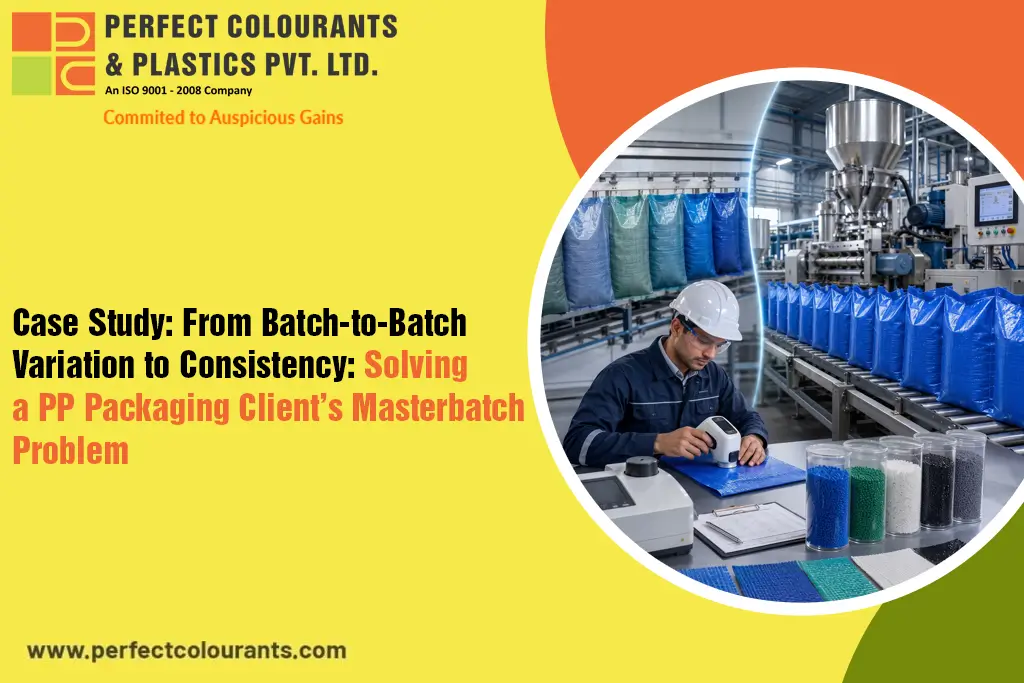
From Batch-to-Batch Variation to Consistency: Solving a PP Packaging Client’s Masterbatch Problem
For a packaging brand, colour is everything. Customers recognise a product through its colour on the shelf. A plastic container with three slightly different colour shades can have a significant impact on customer perception of the brand. This was exactly the issue with one of Perfect Colourants & Plastics Pvt.Ltd, a client’s a rigid polypropylene (PP) manufacturer, approached us. Their containers and closures were coming off in varying colour shades with a visible drift, from lot to lot, forcing the team into shade sorting, blending and at times, rejected consignment. The goal PCPPL had to achieve was to make the colour identical, every batch, every machine, every run.
Client Profile
➤ Industry: Rigid PP packaging manufacturer
➤ Output: Thin-wall containers
➤ End Use: FMCG- food, personal care and lubricants
➤ Process: Injection Moulding
What Was Causing The Colour Variation
Batch-to-batch colour variation is never random. As a top masterbatch producer in India, our technical team reviewed the retained samples across the client’s lots and measured them against a reference. The variation came from several avoidable masterbatch mistakes that undermine PP and PE colour consistency across the industry.
➤ The Resin Did Not Match the PP: The masterbatch used a generic carrier that was never matched to the client’s specific PP. An incompatible carrier disperses unevenly in the melt, hence the shade shift from one batch to the other batch.
➤ A Melt-Flow (MFI) Mismatch: The carrier’s melt index is too far from the base PP. This issue works homogenisation, producing streaking and lot-to-lot swings in colour density that no machine can overturn.
➤ Pigments That Were Not Heat-stable for PP: The pigment chemistry in use was sensitive within the PP processing temperature window. A small change in melt temperatures between machines or shifts was enough to influence the shade. This is the reason why colour varies without changing the recipe.
➤ No Measured Colour Standard: Colour was simply approved manually instead of against a standard reference with defined tolerance. Without a measurement standard, there was nothing to check the batch-to-batch consistency.
➤ Dosing Increased the Problem: A high let-down ratio, combined with volumetric dosing, escalated the inconsistency into visible colour differences across the run.
The main problem we discovered was that the moulding line was never the problem behind colour drifting.
PCPPL’s Approach: Find the Root Problem Then Reformulate
At PCPPL, we believe colour consistency should be designed at the formulation stage and not after. We engineer the masterbatch formulation around the client’s material and process.
➤ Root Cause of Colour Variation Correction: The retained samples were compared and measured on a spectrophotometer against a single reference.
➤ PP-matched Carrier & MFI Engineering: The carrier resin was matched to the client’s PP grade and brought on-par with the melt-flow so the pigment disperses uniformly.
➤ Heat-stable Pigment Selection: Pigments were checked for stability across the full PP processing window, so the shade holds even when the melt temperature varies slightly between machines and shifts.
➤ A Colour Standard: The target shade was fixed against the chosen Pantone/RAL references.
➤ Dosage & Dispersion Optimisation: The letdown ratio was optimised for even dispersion and eliminated feed-driven variation.
The Results
➤ Consistent Shade Across All Batches: Colour is checked batch-to-batch and machine-to-machine, so the appearance stays consistent across all the lots.
➤ Rejection & Shade-sorting Not Needed: With the colour on target across the batches, the client no longer needed to sort, blend or rework lots with varying colouration.
➤ Steadier Process: Even dispersion at an optimised dosage meant a consistent and steady process,
➤ A documented Recipe: Formulation, colour matching and in-house verification with a reliable masterbatch supplier meant no room for inconsistencies and quality issues.
For PP or PE processors facing similar issues, we can imply that batch-to-batch consistency is an important selection decision that needs to be taken before the production run. Match the carrier system to the resin, choose pigments that can withstand the process and follow a proper colour measurement standard.
As India’s largest masterbatch manufacturer in India, we engineer PP-matched, heat-stable colour masterbatch with in-house colour verification so your shade is consistent across all the batches. For custom colours MBs, call us today.